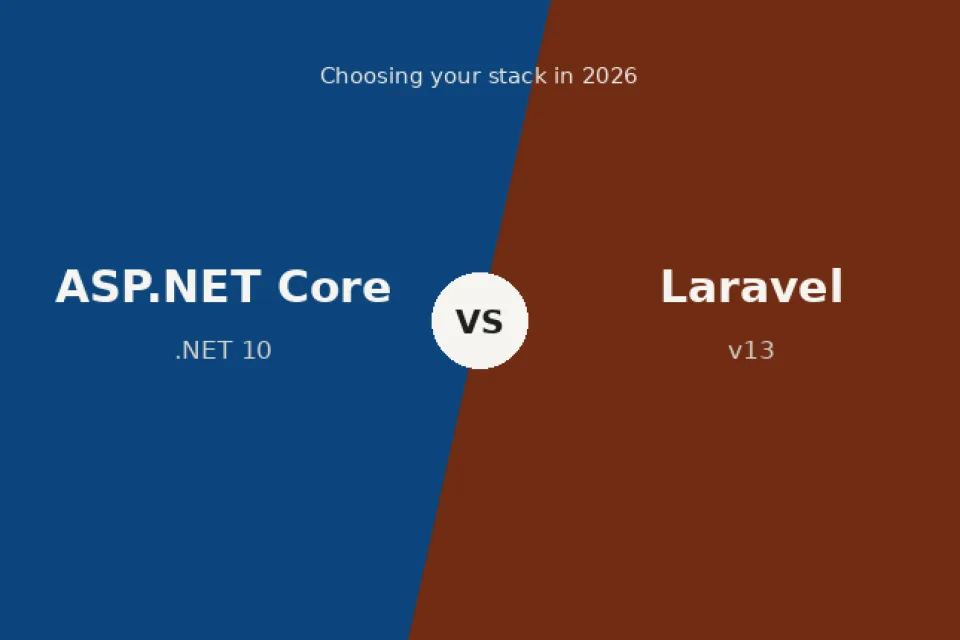
The honest answer is that in 2026, this isn’t really a question about which platform is “better.” Both are mature, well-funded, actively developed, with large ecosystems behind them. The question that actually matters is which one fits the business asking it - the team, the existing infrastructure, the budget, and what the software needs to do. This is the decision process I use with clients, and it’s the one behind the diagram above.
Where both platforms stand right now
.NET 10, released in November 2025, is a Long-Term Support release - Microsoft commits to three years of updates, through November 14, 2028. That matters more than it sounds: .NET alternates between LTS releases (even numbers) and Standard-Term Support releases (odd numbers). Under Microsoft’s current policy, LTS gets three years of support and STS gets two. If you’re starting a new project on .NET today, .NET 10 is the sensible baseline - not because it’s newest, but because it’s the version you can build on without planning an upgrade a year from now. Worth flagging for anyone still running older versions: both .NET 9 and .NET 8 reach end of support on the same date, November 10, 2026, which is a genuinely time-sensitive migration conversation for a lot of businesses, separate from anything else in this article.
Laravel 13 shipped on March 17, 2026. Laravel 13 was deliberately designed as a relatively low-friction major upgrade, with minimal breaking changes compared with what developers might traditionally expect from a major-version bump. More broadly, Laravel’s stated goal is that upgrading between major versions should take a day or less. The main practical requirement is PHP 8.3 as a minimum, so if you’re on an older PHP version, that’s the thing to sort first. Laravel 13 gets bug fixes until Q3 2027 and security patches until March 17, 2028.
Both are, in other words, current, well-supported, and not going anywhere. Neither is the “safe” choice and the other the “risky” one. The differences that actually matter are further down.
The language and the type system behind it
C# is statically typed, which gives the compiler considerably more opportunity to catch mistakes before the application ever runs - type mismatches, invalid member access, and many broken assumptions between components can be identified at build time rather than surfacing later at runtime. That’s not a guarantee against every kind of failure - dependency configuration, data crossing API boundaries, and database state can still go wrong at runtime regardless of language - but it’s a meaningfully larger safety net than PHP offers by default. PHP remains dynamically typed, though modern PHP supports extensive type declarations, and tools like PHPStan can add increasingly rigorous static-analysis checks on top if a team chooses to use them. Laravel 13’s minimum, PHP 8.3, brings typed class constants and further refinements to readonly properties - modern PHP supports enums, readonly constructs, and increasingly sophisticated typing generally, even if none of it is strictly mandatory the way it is in C#.
The practical difference shows up less in raw capability and more in default posture. ASP.NET Core tends to make you declare things explicitly - types, interfaces, dependency contracts - which pays off in large teams and long-lived codebases where you want the compiler enforcing correctness rather than relying on a human to catch it in review. Laravel leans the other way: it optimises for getting something working quickly, with conventions that reduce boilerplate, and lets a team add rigor as a project grows rather than mandating it from day one.
Neither approach is objectively correct, and it’s less about the size of the team than the experience of the specific people on it. For a small team already comfortable with Laravel, especially on a conventional CRUD-heavy product, the lower ceremony can translate into genuinely fast iteration. Equally, a small team of experienced C# developers can move just as fast in ASP.NET Core, because they’re not fighting the tooling - they’re working the way they already think. This is usually one of the biggest factors in the decision, and it’s rarely purely about the language - it’s about how the specific team works, how long the software needs to live, and how much of “correctness” you want the compiler enforcing for you versus relying on discipline and review.
Performance and scale
This is the argument that gets rehashed the most online, and for most business software it’s a smaller factor than the noise around it suggests. .NET’s JIT compiler had another round of real improvements in .NET 10, and for CPU-bound, high-throughput workloads, ASP.NET Core will generally give you more raw performance headroom than a typical Laravel deployment. That’s a genuine, measurable difference, though it’s not simply a “compiled beats interpreted” story - both platforms have moved a long way from that old framing, and PHP’s own runtime has closed a fair amount of ground over the years too.
For most business web applications - CRMs, booking systems, internal tools, marketplaces, content platforms - the actual bottleneck is rarely CPU. It’s database queries, third-party API calls, and network latency, and both platforms handle that class of workload comfortably at the traffic levels most SMEs and even most mid-sized enterprises see. Laravel has closed some of the historical gap here too - Octane boots the application once and keeps it in memory across requests, avoiding much of the repeated framework bootstrap work of a conventional PHP-FPM deployment.
If raw throughput, latency, or compute efficiency is genuinely a first-order requirement for what you’re building - a system processing very large data volumes, or anything with a tight latency budget - ASP.NET Core deserves particularly serious consideration. For most other business applications, this shouldn’t be the deciding factor.
AI features: not really a differentiator anymore
Both platforms made a serious, first-party push into AI over the last year, and it’s worth being precise about what each one actually offers, because the marketing around both tends to overstate the contrast.
EF Core 10, released alongside .NET 10, adds native support for SQL Server’s vector data type and VECTOR_DISTANCE()function, working directly with SQL Server 2025 and Azure SQL Database. Alongside that, Microsoft.Extensions.AI provides a genuinely provider-agnostic abstraction layer, and Microsoft’s Agent Framework supports OpenAI, Anthropic, local models via Ollama, and Microsoft’s own Foundry platform directly - this isn’t an Azure-only story, whatever the “Microsoft” branding might suggest.
Laravel’s first-party AI SDK - announced as beta in February 2026 and still on 0.x version numbers at the time of writing - gives one interface across text, image, and audio generation, embeddings, and tool use, with support for OpenAI, Anthropic, and several other providers. Vector search is supported natively through PostgreSQL with the pgvector extension and MariaDB 11.7 or later, giving Laravel a database-level semantic-search path without requiring a cloud-specific vector service.
The honest comparison isn’t “Laravel avoids lock-in and .NET doesn’t” - both give you a common API across multiple model providers, so provider lock-in genuinely isn’t a meaningful reason to pick one over the other anymore. The real difference is ergonomics and where each fits naturally: Laravel’s AI SDK feels native to how a Laravel developer already works, presented through the same style of API as the rest of the framework. .NET’s approach is more layered - Microsoft.Extensions.AI for abstractions, Agent Framework for agentic applications, EF Core for the data side - which suits teams already comfortable assembling a few purpose-built pieces rather than reaching for one unified package.
Hosting, infrastructure, and the cost that follows you for years
This is where the gap has narrowed a lot but hasn’t disappeared, and it’s worth being precise about what’s actually driving any cost difference. ASP.NET Core itself is free and cross-platform - it runs on Linux, in Docker containers, on any commodity cloud compute, with no Windows Server license required. Postgres works fine with it. None of that costs more because it’s “.NET.”
In organisations already invested in Microsoft infrastructure, a .NET project may naturally sit alongside SQL Server, Azure-managed services, and enterprise licensing. Those choices can carry real ongoing costs. Laravel’s conventional deployment path tends to be open-source by default: Linux, PostgreSQL or MySQL, with no proprietary server or database licence inherently required.
For a small or mid-sized business, this is worth costing out concretely against your actual plans rather than assumed from reputation. Ask specifically: will this project pull us toward SQL Server and Azure licensing, or are we deliberately staying on open infrastructure - and what does either path cost over a few years, not just at launch.
Talent, hiring, and who’s going to maintain this in three years
Software outlives the decision to build it, and who you can hire to maintain it matters as much as anything else on this list - though this is where I’d be most cautious about treating anecdote as a universal rule, since hiring markets vary enormously by geography, seniority, and sector.
In the UK agency and SME market we work in day to day, Laravel and PHP talent is widely available across agencies, freelancers, and smaller development teams, which generally makes hiring and scaling a small team more straightforward. .NET talent is also deep, but we encounter more of it concentrated in enterprise, corporate, and government-adjacent environments, reflecting where that skill set has traditionally been deployed. That’s our experience in this specific market, not a global law about either language - a business in a different sector or region may find the opposite is true locally, and it’s worth checking your own hiring pool rather than assuming.
Where existing infrastructure decides it for you
Sometimes none of the above matters much, because the environment you’re already in makes the decision. If your business runs on Windows Server, Active Directory, SQL Server, and existing internal systems built in .NET - common in government, education, and larger regulated organisations - building the next system in ASP.NET Core means it integrates naturally with authentication, existing databases, and tooling your IT team already understands. Introducing Laravel into that environment may be perfectly possible, but it creates another stack for the organisation to integrate, deploy, secure, and maintain - and that additional complexity often isn’t buying much.
But where there’s no existing infrastructure pulling in either direction, team experience should carry real weight. Introducing .NET to a team that already works effectively in Laravel creates a learning cost, just as introducing Laravel to an experienced .NET team would. The question is whether the benefits of changing stack justify that cost for this particular project.
The actual decision, stripped down
None of this needs to be complicated. Before choosing, it’s worth being specific about a handful of things:
| Question | What it tells you |
|---|---|
| What does the existing team know best? | Delivery speed and maintenance risk |
| What infrastructure already exists? | Integration and operational complexity |
| Is unusually high throughput or low latency actually required? | Whether raw framework performance should materially influence the choice |
| What will the stack cost over 3–5 years? | Real total cost of ownership, not launch cost |
| Who will maintain it later? | Long-term hiring and support risk |
Answer those honestly and the choice usually becomes obvious - the framework debate online is louder than the actual decision most businesses need to make.
At Niletech, we build in both - ASP.NET Core and Laravel - for exactly this reason. We’ve delivered government and enterprise systems in .NET, and property, SaaS, and business platforms in Laravel, and the recommendation we give a client depends on their specific situation, not on which stack we’d personally rather write in that week. If you’re weighing this decision for a real project and want a second opinion grounded in what you’re actually trying to build, that’s a conversation we’re happy to have.
External sources:
- .NET 10 release & LTS support window - Announcing .NET 10 (.NET Blog)
- .NET support policy (LTS vs STS, end-of-support dates) - .NET and .NET Core official support policy
- Laravel 13 release details - Laravel 13 release notes
- Laravel’s upgrade philosophy (“a day or less”) - Laravel upgrade guide
- Laravel AI SDK (beta announcement, provider support, vector search) - Laravel AI documentation
- EF Core 10 vector search /
VECTOR_DISTANCE()- What’s new in EF Core 10 - Microsoft.Extensions.AI (provider-agnostic abstraction) - Microsoft.Extensions.AI libraries overview
- Agent Framework provider support (OpenAI, Anthropic, Ollama, Foundry) - Microsoft Agent Framework overview